Saturday, July 10, 2010

Must-have Android apps

android-logo A few months ago I traded in my Windows Mobile phone for an Android device. From the research I did back then, going over to the Android platform seemed like the most natural thing to do, given my requirements. And I haven’t regretted it since.

Sporting a fantastic user interface, spiffy response, plenty of great apps that can be downloaded and installed over the air, and the ability to synchronize all of my contacts and calendar information with the Google cloud makes it a very compelling proposition indeed. I’m also pretty happy with the capabilities and features on my Samsung i7500 Galaxy (5PM camera, LED flash, WiFi, Accelerometer, GPS, 3.2-inch AMOLED screen et al), though support is a different issue altogether—Samsung seems to have completely forgotten about this phone in their firmware update strategy. Be that as it may, Android is a great platform and one that I think I’ll be with for a while. Going by the industry and consumer support, and the strides they’re making with each release, Android is certainly in it for the long run.

I’ve tried out numerous apps from their store—some great, some that I disposed of not long after using them. So in no particular order (and in debatable classification), here are the ones that are on my phone to stay:

Fun

Shazam: Undoubtedly cool: can’t recall the name of that song on the radio? Shazam it!
Layar: A great augmented reality browser—you’ve got to use it to experience it
FxCamera: Fun image effects with your camera phone
Google Sky: Totally awesome—point your phone at a star and it pulls up info on it!
Foursquare: The social networking app that’s making waves—especially useful if you’re a party animal/pub crawler/foodie
Facebook: If you have a Facebook account (what? you don’t??) you’ll need this on your phone
10001 Cocktails: ‘nuff said
Barcode scanner: Works with most barcodes—fun to show off with
Fartdroid:
Yes, it is. Loads of laughs, and with timed release!
Schottgunn: A fun, senseless shotgun simulation app
AK-47: Like Schottgunn: a fun, senseless AK-47 app
Tesla sparks: Touch the screen and see groovy tesla sparks. Pointless. Fun.
The Schwartz Unsheathed: The glory of the Jedi light sabre in your Android phone—complete with cool sound effects!
Air horn: Great for waking up your colleague dozing off in the next cubicle at 3PM!

Productivity

Fring: A VOIP telephony app that connects to MSN, Google, Skype etc
K9 Mail e-mail client: A pretty feature packed and capable POP/SMTP mail client
AK Notepad: Great notepad/reminder application
Voice Recorder: Turns your Android into a dictaphone
Thesaurus: Never be at a loss for words
Wapedia: Wikipedia on your phone

Utilities

SlideIT: An excellent, intuitive alternative to Android’s default on-screen keyboard
Wifi Static: Switch Wi-Fi profiles, along with your phones’ IP configuration
Locale: Auto-switch features of your phone (ringer, Wi-Fi, bluetooth etc) based on your location
Astro file manager: Must, must have file manager
Opera Mini 5 Beta: An Android port of the browser you know and love
Dolphin browser:
A pretty cool browser; try it and you might like it
Ringdroid: Intuitively slice MP3s files right on your phone, then save them as ringtones!
Google Translate: Very handy if you’re travelling, or want to impress your better half with a pseudo-knowledge of French of Spanish
Photoshop for Android: A very scaled-down version of the bloatware imaging app we all know and love. No, it’s actually pretty nice.
MyBackup: Backup all of your Android’s data—great when flashing your phone
Android Agenda Widget: A neat widget that puts important calendar entries right up there on your home screen

Games

Poke-a-mole: Totally fun and very addictive
Trap: A very neat, and very addictive game—hard to explain, easy to get the hang of. Try it!
Hit the Penguin: If you’ve played the online Flash version, you’ll love this one
Abducted: Nice time-killer, uses your phone’s tilt sensor
Replica Island: Great 2D-side scrolling adventure game with neat graphics
Throttle copter: A fun side-scrolling ‘copter game
Paper toss: My favorite!
Chess: Uses a pretty challenging engine
Pinball: Yep, a classic way to kill time
Labyrynth Lite: A fun maze game that uses your phone’s tilt sensor

Thursday, June 3, 2010

Four steps: From point-and-shoot to pro!

Being a good photographer is more than just having the best equipment or getting plenty of practice. To be able to truly ‘tell a story’ through imagery, there are certain rules of thumb I’ve come to learn—rules that can almost instantly notch up photography skills. Here, then, is a quick list of points to bear in mind each time you’re poised to click that shutter button, and a few associated techniques I use that can help nail that shot.

Focus: Even the best software and most advanced computer cannot save a photograph that’s out of focus. Unless you intentionally want blur in your photograph, you absolutely and positively need to ensure that the key subject in your shot is in focus.
viewfinder Technique: Master the art of pre-focusing the camera before shooting. Pre-focusing or focus lock is a mode that almost every digital camera has—it’s what enables you to half-press the shutter button (during which time the camera focuses, calculates exposure, and blazes through all the processing required to take that shot). The actual photo is captured only when you completely press the shutter release button and you hear the ‘click’. So, yes, get used to pre-focusing.
Next, Look through your camera’s viewfinder and you’re likely to see a pattern similar to the one shown above. This pattern helps you determine how the camera focuses. In this case, the five double-bracket boxes indicate the five focusing zones the camera uses to determine which part of the scene to focus on. The box in the center of the viewfinder is your best friend—set your camera to ‘Center Focus’, the mode that only considers that center reticle as the focus point. Then point the camera so that the center point is on the subject, half-click, then reposition the view to frame as required before completely clicking. This technique will ensure your key subjects are always in focus—no more blurry person in the foreground and sharply focused (but boring) trees in the background.

Composition: Composition is the process of framing your scene, so that there’s a balance The historic Pigeon Point lighthouse on Highway 1among all of the elements. When looking at a scene through your camera, think of the scene as being divided into imaginary thirds, both horizontally and vertically (see the lighthouse example here). As a rule of thumb, aligning the key elements in your scene with these ‘third’ positions is proven to lend balance to photographs. Sure this is subjective, but view online examples using the ‘rule of thirds’ and you’ll see what I mean.
Technique: The trick is to frame your scene so that the key elements get the most ‘visual weightage’ and the lesser elements are eliminated. Feel free to also use the zoom, or move and change your perspective until you find the right frame. Hint: Use the focus lock technique described earlier right before you frame. That way you can focus on your key subject, then move it to a different part of the frame for creative composition before clicking to capture the photo. Even after you’ve shot the photo, feel free to crop your image to eliminate unnecessary elements (for example, random people at the edge of the photo, or an intrusive tree branch spoiling an otherwise good portrait).

Exposure: Exposure is actually a pretty complex part of photography, and one that is integral to the art. It is the process of determining the correct shutter speed, aperture and film speed, which determines how much light is captured by the camera. Fortunately, today’s digital cameras do all of the hard work for us, and compute these values in a blink of an eye during the time it takes to press the shutter button! Correct exposure means that the key element of interest in the photo (be it a model, car, landscape or pet) looks naturally lit—not to dark or too bright.
Exposure Technique: As a rule of thumb, if your key subject looks badly lit (too dark or too bright), point the camera so the subject is in the center of the frame, then focus lock (yeah, focus lock again—it’s that invaluable!), then reposition to frame the scene as you desire before clicking. If you’re so inclined (and if your camera supports it), play around with the shutter speed or aperture to make your camera take in less or more light from the scene (higher shutter speed or higher aperture number=lesser light into the camera, and vice versa). Take heart—minor mistakes in exposure can be fixed using software like Adobe Photoshop or Lightroom, or even photo managers like Picasa.

Subject: Finally, a good photo also depends on how good the subject is, so keep your Shastaeyes peeled for great photo opportunities. Good photo ops needn’t be posed; even the most mundane of scenes—the rapture of a dog playing in the street, or the thematic contrast of an old man standing beside a little child—are great photo ops.

Technique: The trick is to get sensitized to noticing these opportunities—very often the real photo is not immediately apparent. You need to move around, sometimes change your point of view to notice a potentially great shot. Even for posed photos, try to set up the scene to bring the best out of your subject. Make them smile, grant importance to key attributes in their personality, or try to reposition them so they’re in soft lighting where possible (maybe shoot in the natural light of dawn or dusk).

At the end of the day, the secret lies in technique. You don’t need to master every mode of your camera to be able to take photos that tell a story, but bringing the elements above together will lift your photography from amateur to a definitive prosumer. Beyond these basics, there are several methods available that can lift your photography even higher—image processing, HDR etc. But that’s another story. Best of all, digital photography is forgiving when it comes to practicing: hit the delete button and start over! So go ahead—experiment away.

Friday, April 23, 2010

The holy grail of computer graphics

God of War III When it comes to serving up high-quality graphics on a computer, we’ve come a long, long way indeed. From the days of Pong, Atari and the Commodore 64, we now have supercomputing-class boxes in our very home in the form of devices like the PlayStation 3. Even computers, with their graphics card containing fancy components like stream processors that boast of delivering realistic graphics in games and visualization applications, there doesn’t seem to be any slowdown in the pace of innovation in this exciting sector of computing. Computer graphics bigwigs like ATI and Nvidia continue to pursue the honor of being top-dog graphics company by creating more powerful graphics processors, more transistors and ever higher clock speeds.

The story so far
All 3D scenes are composed of little ‘facets’ called polygons—the greater the number of polygons to build a 3D model, the greater the detail. Faster processors enable faster polygon processing, resulting in more detailed scenes that can be rendered quicker. Simple, right? However, this approach is not necessarily one that is extensible, especially given that these days chip fabrication processes are pushing the 55 nanometer range (which is very close to atomic dimensions). So physically, there’s every possibility of running into a stone wall in the near future—it is not possible to fabricate at sub-atomic dimensions. Unless of course scientists make massive leaps in practical quantum physics. But that doesn’t look likely.

The game changer
So along comes a self-taught enthusiast from Australia called Bruce Dell, who proposes a completely different graphics rendering paradigm called Unlimited Detail. He suggests that polygon-processing capabilities should no longer be the baseline of graphics computing prowess. The idea is to treat every point of light on your monitor (yes, the pixels) as the prime element in the 3D scene. In the 3D world, these discrete points are called voxels (many of which make up point clouds). With Unlimited Detail, Dell claims that the rendering engine now acts much like a search engine that basically just decides which points of light to show on the screen, depending on the particular view that needs to be displayed in that 3D scene, the resolution of the screen and other such factors. This approach can drastically cut down the amount of processing power required, as the rendering engine only concerns itself with showing what a user sees. The net result? Hyper-realistic 3D imagery that can be rendered completed in software, with no special hardware support required. I know, it does sound too good to be true. It’s still early days for this technology, but this proof-of-concept demo of Unlimited Detail here provides a compelling argument indeed.

Unlimited Detail - an explanation

There’s another video from the creator of this technology, where he provides a more narrative explanation of how this technology contrasts to the current-day approach.

If this technology does take off, I can’t wait to see God of War 4 in Unlimited Detail. Wow.

Thursday, June 18, 2009

Mobile gaming: Augmented reality with the Nvidia Tegra

tegra_3d_largeThese days, consumers increasingly want to take their experiences with them—be it gaming, movies, music, or the Internet. Devices like the Sony PSP, the iPod, multimedia cellphones, and video-capable portable media players do just this—they provide entertainment no matter where you are. But when it comes to portable devices, there are several invisible yet real barriers to a good experience—battery life and processing power. Manufacturers are grappling with these very issues while developing the next funky cell phone or portable gaming device. The Holy Grail lies in the ability to integrate console-class graphics capabilities with day-long battery life. And it looks like Nvidia (a leader in the development of processors for gaming and visualization) is very close to that elusive goal. With the launch of their Tegra processor, they can now offer phone and handheld game device manufacturers the ability to play high-definition movies and desktop class games on portable devices. If you’re a gamer, think Doom 3 class graphics on a handheld device. If you’re movie buff think watching 1080p-class high-definition video on a ultra-crisp portable OLED screen.

It gets better—when you marry the inherent portability of devices like cell phones and Mobile Internet Devices with the fact that they have fairly high-resolution cameras, something amazing happens. Check out the video below of a portable device powered by the Tegra processor, and how developers have been able to ‘augment’ the game on screen with the real word as seen through the mobile camera. Very, very cool.

Augmented reality enabled by the Nvidia Tegra processor


Imagine owning a phone in the near future having this kind of capability, and running around a table-top map with friends in a multiplayer game, or even taking the game outside the house and augmenting the undead into your quiet neighborhood—sounds trippy! Only problem I see is gamers of the future having to grapple with the inability to detach themselves from their virtual world, and get back into the here and now. But hey, it’d be a fun ride before that.

Marketing folks have already jumped onto the augmented reality bandwagon—check out this cool marketing campaign by Ford UK, to promote the launch of the Ford Ka.

Wednesday, May 13, 2009

All-time great sci-fi movies of the videotape era

When it came to figuring out what to do with my life, there never really was any doubt about what I’d become—an engineer. I remember the numerous times I stoically opened those steel wind-up alarm clocks, to see what made them tick, or took apart music systems (even my VCR, when I was all of 10 years old, to find out how to un-jam that tape!). Needless to say, not all of these exploits were successful—in fact, most were outright disasters. Over the years, I left behind a sizeable wake of cannibalized motors from toys, wrecked stereo systems, and bed sheets that bore scars from trysts with 240-volt electricity (yes, there was the time I nearly got a nice domestic fire going—and we didn’t have a fireplace).

Sure I had my fair share of chastising, but through it all mum and dad did all they could to ensure that I had a steady supply of science and technology influences throughout my formative years—from the junior microscope sets, to telescopes, to electronic do-it-yourself kits. I was, indeed, blessed.

But when it came to igniting a spark of interest in the budding scientist in me, the biggest influencers had to have been movies—I believe the 80s produced some of the most spectacular science fiction movies ever created. Looking back, the fact that the special effects were nowhere as advanced as today’s productions did in no way detract the sheer innovation and soul that characterized many of those movies. Being the era of VHS (where copying was cumbersome and downloading was out of the question), every movie was treasured, and the act of watching it was a family affair, often followed by hours and days of animatedly discussing, dissecting and reliving the storyline.

In no particular order, here’s a list of what I believe are some of the greatest sci-fi movies of the videotape era. If you ever get a chance to watch any of these, I guarantee that they’ll be pure, family entertainment. And if you have a budding techie sitting on the couch in your living room, (s)he’s bound to have great memories of them in the years ahead.

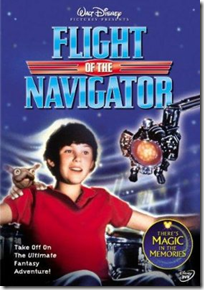
Flight of the Navigator (1986)
A fascinating story about a UFO that selects and befriends a boy to help it get back home. I still think that this is one of the most amazing-looking UFOs ever shown on celluloid. Period.
FlightOfTheNavigator
D.A.R.Y.L. (1985)
Another movie that centers around a young boy, who’s the subject of NASA experiments that make him hyper-intelligent. And the best part of this movie (spoiler alert ahead!)—in the end he flies a Lockheed SR-71 Blackbird—my favorite aircraft, bar none!
DARYL
TRON (1982)
Conceptually, this movie was way ahead of its time—a computer geek gets mysteriously transported into a computer, and must battle his way to get out alive—by fighting against its games, one on one! This movie had one of the most spectacular effects of its time, and the action sequences (on those bike thingies, especially), were awesome!
BTW: TRON was a function used in good ol’ programming languages like BASICA, meaning TRaceON—it was used for debugging!
TRON
Return to Oz (1985)
If you liked the Wizard of Oz, you’re bound to love this movie. This isn’t a happy, bouncy continuation of the original, but instead puts Dorothy and her band of misfits in a darker, more sinister realm. Fascinating story, great characters.
ReturnToOz
Return of the Jedi (1983)
Which geek doesn’t revere this movie? This was actually the first Start Wars episode I watched, and I instantly fell in love with every aspect of it. After this movie, there was no looking back from Han Solo, the Light Sabres, and Vader.
ReturnOfTheJedi
Short Circuit (1986)
A charming movie about a battle robot that takes on human characteristics after a close encounter with a lightening bolt. Besides looking downright cute in its own right, this robot is actually quite evocative of our modern-day Wall-E.
ShortCircuit
Back to the Future (1985)
A sports car that doubles up as a time machine, hover skateboards, and a host of other cool gadgets—ingredients for one rocker of a sci-fi movie! Because of this movie, the gull-wing DeLorean was one of my favorite sports cars at the time. Arguably one of Michael J. Fox’ most memorable roles, this is one of those must-see, must-own pieces of cinemagic!
back_to_the_future
*batteries not included (1987)
Looking back, I think this is a grossly underrated movie—it’s a story about an adorable pair of extra-terrestrial robots that ‘adopt’ a tenement-full of misfits. A brilliant story, and great visual effects.
batteries_not_included
E.T.: The Extra-Terrestrial (1982)
Spielberg’s magnum opus. ‘nuff said.
ET
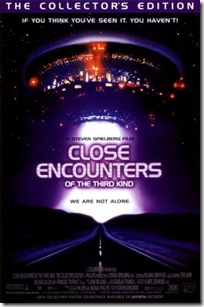
Close Encounters of the Third Kind (1977)
Answering all those questions surrounding aliens and UFOs, this movie was a complete eye-opener, and a visual tour de force of its time.
Close Encounters of the Third Kind

All images sourced from www.imdb.com

Related Posts with Thumbnails